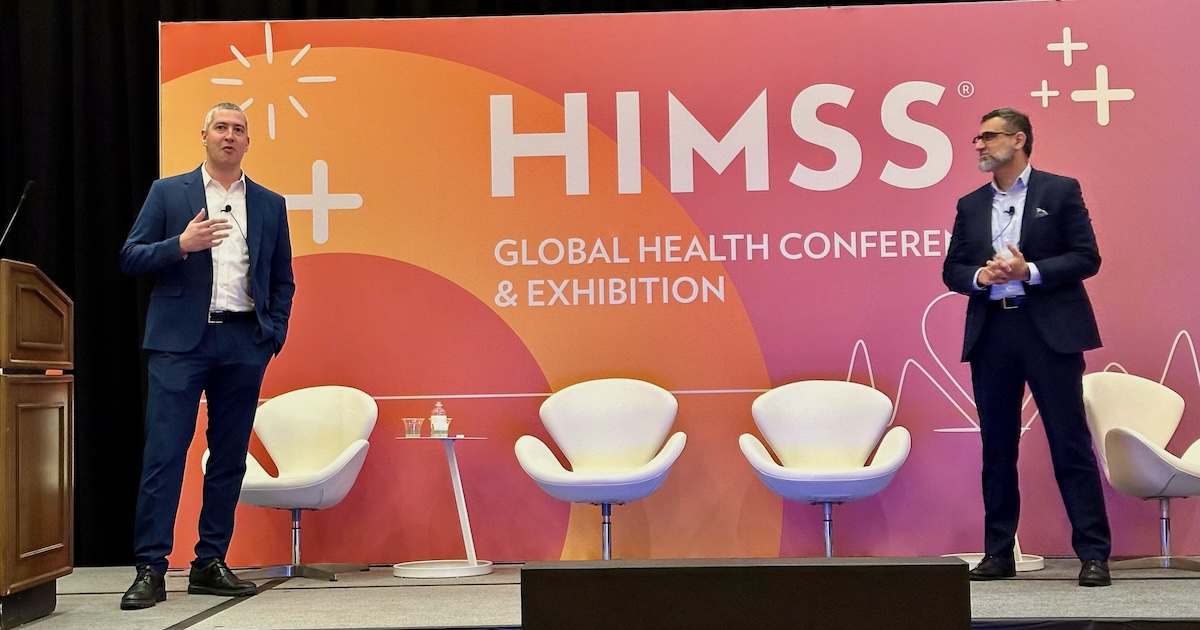
ABC News Live anchor Lindsay Davis and Oscar-nominated actor Jeremy Renner
Photo courtesy of Jessica Hagen
LAS VEGAS – During the closing keynote at the 2026 HIMSS Global Health Conference & Exposition here on Thursday, Oscar-nominated actor Jeremy Renner shared an emotional account of his recovery from a near-fatal accident on New Year's Day 2023, which crushed him and caused blunt chest trauma and 38 broken bones.
Renner was critically injured when a 14,000-pound snowcat ran him over as he attempted to protect his nephew by stopping the machine. The accident left him with severe injuries, requiring extensive hospitalization, numerous surgeries and a long rehabilitation process.
Speaking with ABC News Live anchor Lindsay Davis, the actor recalled the moment he realized what happened to him, the severity of his injuries and how he felt when help had arrived after lying injured in the snow.
"I became patient number one that moment on New Year's Day, like three years ago," Renner said. "So, there's a great sort of life and death and coming back from death. And then first responders show up, and then Care Flight, and a whole team of amazing nurses and doctors and surgeons put me back together again."
The actor said the experience fundamentally shifted his outlook on life, especially his priorities around physical and mental healthcare.
"Nothing in my life, nothing has changed, but my perceptions, my perspectives, my priorities, all those have shifted – big, big, giant shifts in those. My life in itself generally operates the same," Renner said.
The actor credited his first responders, nurses and physicians with saving his life, but emphasized challenges navigating the complex healthcare system, including frustrations he had from moving from one ICU to another.
While Renner praised clinicians for saving his life, he said the experience also exposed gaps in communication across care teams.
"I remember I was out of the danger of dying, and then I had to go now to the second ICU in LA to work on my face. I had three breaks in my mandible, my orbital bone was cracked, my eyeball came out, and then a couple of breaks in my cheekbone, and they're just poking around at my face. So, the doctors in LA were going to fix that, and then a couple other body parts," Renner said.
He expressed frustration, though, over the process of receiving that valuable care. He said that during his hospital stay, he had a team of around eight doctors, and he was receiving X-rays and blood draws over and over again, with none of the doctors communicating with each other.
"There's blood doctors, the bone doctors – there's two bone doctors, one just for my face and [one for] the rest of my 38 broken bones – so everyone needed certain things for them to do their job efficiently, effectively in the time, but nobody was communicating to each other, and that's why I'm doing all these blood tests," Renner said.
"Everything was so segregated. Nobody was talking to each other. It was like the quarterback to it all, ultimately, was that nobody was understanding my real frustrations as a patient."
Renner emphasized the need for communication between care teams, the lack of which caused excess tests to be done as well as continuous blood draws in the middle of the night that would wake him from his sleep, which, ultimately, he said, caused him more pain and frustration.
"I started to get angry, and I wasn't just being surly and trying to be funny and surly, I was actually really getting really, really upset. So I started crying to the point where they had to have a therapist come in and say, like, 'What do you need?'" Renner said.
"I'm like, I need a bouncer at my door to keep everyone out. Let me f**king sleep!"
He relayed his thanks to the doctors and nurses who helped him, but stated that if he could recommend anything, it would be to increase data sharing.
"If I have an opinion, it would be that I wish there was some sort of way that data got passed around, especially in emergency situations, and not just in a hospital setting," Renner said.
"From dispatch to first responders [and so on]. I started working with this company called RapidSOS that is just that and uses AI to collect the data that's necessary and passes it to the people who need it and need it the most."
He said patients' information should be passed around to their care team, even from the first people on the scene, like paramedics and Care Flight, to the doctors treating them in the hospitals.
He emphasized that all data should be consistently available and accessible throughout the entire healthcare journey.
"If we know the data, we could help our helpers and protect them as well. You know, it helps them help us better. So, let's protect the ones that help us most and love us most," Renner said.
He emphasized the importance of "helping our helpers" as he reflected on the emotional strain he saw in healthcare workers' faces during his care journey.
"It became really, really important for me to think about our healthcare system and how we can be more efficient in it. It's 'help our helpers.' That, to me, is kind of like the takeaway outside of my recovery. It's like, I really do care about our healthcare system, and how can we make it better?" Renner said.
"There's a real emotional impact that happens, especially in an ICU, NICUs or ERs," Renner said. "You're working in chaos every day. Where's the mental healthcare for them?"
Today, Renner said the accident has given him a deeper appreciation for everyday moments and reinforced the importance of preventive healthcare, including cellular health and blood health.
"I think preventative healthcare is huge. I don't think we are taught that, even in healthcare, right? It's preventative measures. We've gotten so dependent on pills and all these other things ... that are great! I don't s*it on the pills, right? They're awesome. But I think people just can't prescribe stuff, and we should be doing something different in society, I think, do preventative stuff," Renner said.
He said individuals can participate in their health by getting blood panels, which are "great report cards" on what the body is doing and not doing, and can find signs of disease earlier.
"You've got to take ownership of your own health, and there are easy ways to do it. And so let's help our helpers by helping ourselves first," Renner said.